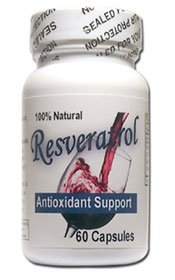
4 Bottles - High Potency Resveratrol 500 mg. Standardized ExtractEach bottle retails for $29.99, but is available here 70% off - just $38.99 for Four BottlesAll bottles are fresh, factory sealed with an expiration of 6/2012. Each bottle contains 60 capsules and is a 1 month supply. Product is Rushed Priority Mail 2-3 day service. Shipping is FREE.Benefits of Resveratrol:Just some of the benefits of Resveratrol cited include:- anti-aging- anti-cancer- anti-cholesterol- lowers risk of heart attacks and strokes- blood pressure and blood sugar-normalizing agent- life extension properties- metabolic support of the immune system- improved sports performance- anti anxiety properties- anti depressant- antioxidant- anti-inflammatoryWhat is Resveratrol?Resveratrol is a naturally produced compound found in red grapes, fruits, berries and root extracts.Resveratrol has some of the highest concentration anti-oxidants levels. It is commonly found in Red Winethrough grape pulp. Rich molecules provide a natural detoxification of muscle and fat tissue that arecaused by years of build up due to airborn and terrestrial toxins. By consuming a safe daily dose ofResveratrol, you can start the break down process which will naturally help shed pounds and trim fatty areas.Resveratol is being touted as a real "fountain of youth" and has received substantial media coverage including: 60 Minutes, Oprah, Barbarah Walters, Many prestigious Medical Journals and virtually every news channel and newspaper.For centuries, red wine has been linked to numerous health benefits. But this new study, published onlinein the journal Nature, shows that mammals given ultrahigh doses of Resveratrol benefit from positive effectsof cutting calories without actually doing it. "If we're right about this, it would mean you could have thebenefit of restricting calories without having to feel hungry," Sinclair said. "It's the Holy Grail ofaging research."Scientific ReferencesLife extensionThe groups of Howitz and Sinclair reported in 2003 in the journal Nature that resveratrol significantlyextends the lifespan of the yeast Saccharomyces cerevisiae. Later studies conducted by Sinclair showedthat resveratrol also prolongs the lifespan of the worm Caenorhabditis elegans and the fruit fly Drosophilamelanogaster. In 2007, a different group of researchers was able to reproduce Sinclair's results with C.elegans, but a third group could not achieve consistent increases in lifespan of D. melanogaster or C. elegans.In 2006, Italian scientists obtained the first positive result of resveratrol supplementation in a vertebrate.Using a short-lived fish, Nothobranchius furzeri, with a median life span of nine weeks, they found that amaximal dose of resveratrol increased the median lifespan by 56%. Compared with the control fish at nineweeks, that is by the end of the latter's life, the fish supplemented with resveratrol showed significantlyhigher general swimming activity and better learning to avoid an unpleasant stimulus. The authors noted aslight increase of mortality in young fish caused by resveratrol and hypothesized that it is its weak toxicaction that stimulated the defense mechanisms and resulted in the life span extension. Later the same year,Sinclair reported that resveratrol counteracted the detrimental effects of a high-fat diet in mice.The high fat diet was compounded by adding hydrogenated coconut oil to the standard diet; it provided 60% ofenergy from fat, and the mice on it consumed about 30% more calories than the mice on standard diet. Both themice fed the standard diet and the high-fat diet plus 22 mg/kg resveratrol had a 30% lower risk of death thanthe mice on the high-fat diet. Gene expression analysis indicated the addition of resveratrol opposed thealteration of 144 out of 155 gene pathways changed by the high-fat diet. Insulin and glucose levels in mice onthe high-fat+resveratrol diet were closer to the mice on standard diet than to the mice on the high-fat diet.However, addition of resveratrol to the high-fat diet did not change the levels of free fatty acids andcholesterol, which were much higher than in the mice on standard diet. A further study by a group ofscientists, which included Sinclair, indicated that resveratrol treatment had a range of beneficial effects inelderly mice but did not increase the longevity of ad libitum-fed mice when started midlife.Cancer preventionIn 1997, Jang reported that topical resveratrol applications prevented the skin cancer development in micetreated with a carcinogen. There have since been dozens of studies of the anti-cancer activity ofresveratrol in animal models. No results of human clinical trials for cancer have been reported. However,clinical trials to investigate the effects on colon cancer and melanoma (skin cancer) are currently recruitingpatients. In vitro resveratrol interacts with multiple molecular targets (see the mechanisms of action), andhas positive effects on the cells of breast, skin, gastric, colon, esophageal, prostate, and pancreatic cancer,and leukemia. However, the study of pharmacokinetics of resveratrol in humans concluded that even high doses ofresveratrol might be insufficient to achieve resveratrol concentrations required for the systemic prevention of cancer.This is consistent with the results from the animal cancer models, which indicate that the in vivo effectiveness ofresveratrol is limited by its poor systemic bioavailability. The strongest evidence of anti-cancer actionof resveratrol exists for tumors it can come into direct contact with, such as skin and gastrointestinal tract tumors.For other cancers, the evidence is equivocal, even if massive doses of resveratrol are used. Thus, topical applicationof resveratrol in mice, both before and after the UVB exposure, inhibited the skin damage and decreased skin cancerincidence. However, oral resveratrol was ineffective in treating mice inoculated with melanoma cells. Resveratrolgiven orally also had no effect on leukemia and lung cancer; however, injected intraperitoneally, 2.5 or 10 mg/kg ofresveratrol slowed the growth of metastatic Lewis lung carcinomas in mice. Resveratrol (1 mg/kg orally) reduced thenumber and size of the esophageal tumors in rats treated with a carcinogen. In several studies, small doses(0.02-8 mg/kg) of resveratrol, given prophylactically, reduced or prevented the development of intestinal and colontumors in rats given different carcinogens. Resveratrol treatment appeared to prevent the development of mammarytumors in animal models; however, it had no effect on the growth of existing tumors. Paradoxically, treatment ofpre-pubertal mice with high doses of resveratrol enhanced formation of tumors. Injected in high doses into mice,resveratrol slowed the growth of neuroblastomas.Athletic performanceJohan Auwerx (at the Institute of Genetics and Molecular and Cell Biology in Illkirch , France ) and coauthorspublished an online article in the journal Cell in November, 2006. Mice fed resveratrol for fifteen weeks had bettertreadmill endurance than controls. The study supported Sinclair's hypothesis that the effects of resveratrol areindeed due to the activation of the Sirtuin 1 gene. Nicholas Wade's interview-article with Dr. Auwerx states that thedose was 400 mg/kg of body weight (much higher than the 22 mg/kg of the Sinclair study). For an 80 kg (176 lb) person,the 400 mg/kg of body weight amount used in Auwerx's mouse study would come to 32,000 mg/day. Compensating for thefact that humans have slower metabolic rates than mice would change the equivalent human dose to roughly 4571 mg/day.Again, there is no published evidence anywhere in the scientific literature of any clinical trial for efficacy inhumans. There is limited human safety data (see above). Long-term safety has not been evaluated in humans.In a study of 123 Finnish adults, those born with certain increased variations of the SIRT1 gene had fastermetabolisms, helping them to burn energy more efficiently—indicating that the same pathway shown in the lab miceworks in humans.Neurodegenerative diseaseIn November 2008, researchers at the Weill Medical College of Cornell University reported that dietary supplementationwith resveratrol significantly reduced plaque formation in animal brains, a component of Alzheimer and otherNeurodegenerative diseases. In mice, oral resveratrol produced large reductions in brain plaque in thehypothalamus (-90%), striatum (-89%), and medial cortex (-48%) sections of the brain. In humans it is theorizedthat oral doses of resveratrol may reduce beta amyloid plaque associated with aging changes in the brain.Researchers theorize that one mechanism for plaque eradication is the ability of resveratrol to chelate (remove)copper.